Tissue repair was one of the first observed effects of low-level light, and it remains one of the best-supported. Studies in cells, animals and patients show wound healing can be induced by many different wavelengths and powers, although an optimal set of parameters has not yet been defined.[1]
Cancer care: oral mucositis
Painful mouth sores (oral mucositis) are a common side effect of cancer treatment. After a systematic review, the MASCC/ISOO clinical practice guidelines recommend PBM to prevent oral mucositis in patients undergoing hematopoietic stem cell transplantation or head and neck radiotherapy (with or without chemotherapy), using specific validated protocols. The evidence was insufficient for treating established mucositis.[2]
Ulcers and radiation dermatitis
The 2025 multidisciplinary consensus in the Journal of the American Academy of Dermatology concluded that PBM is an effective treatment option for wound ulcers of multiple causes, decubitus (pressure) ulcers, pain from diabetic foot ulcers and acute radiation dermatitis.[3]
Important
These are clinical applications delivered by trained professionals with specific parameters. Any wound that is not healing should be assessed by a doctor — do not self-treat chronic wounds with a consumer device.
Real results from the research
Photos from the studies behind this topic, shown unaltered with their protocols.
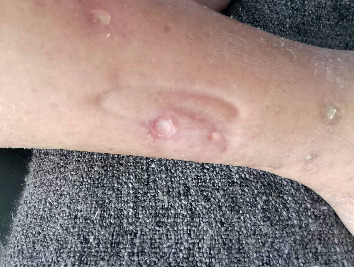
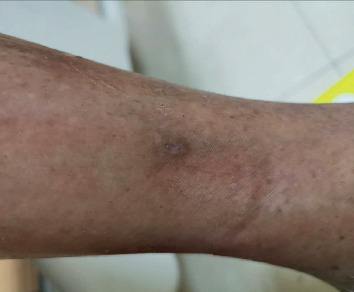 BeforeAfter
Diabetic leg ulcers in an 84-year-old woman: first observation (Figure 1) vs complete healing after 30 days (Figure 5). Single case report.
Protocol: Self-administered at home with an 808-nm near-infrared laser device (B-Cure Laser Pro), 2 x 15-min sessions per application, 30 days.
Image: Merigo E et al., Case Rep Med (2020), Figures 1 & 5 · CC BY 4.0 · Source ↗ · doi:10.1155/2020/7428472
Individual results vary. Shown unaltered, as published by the source.
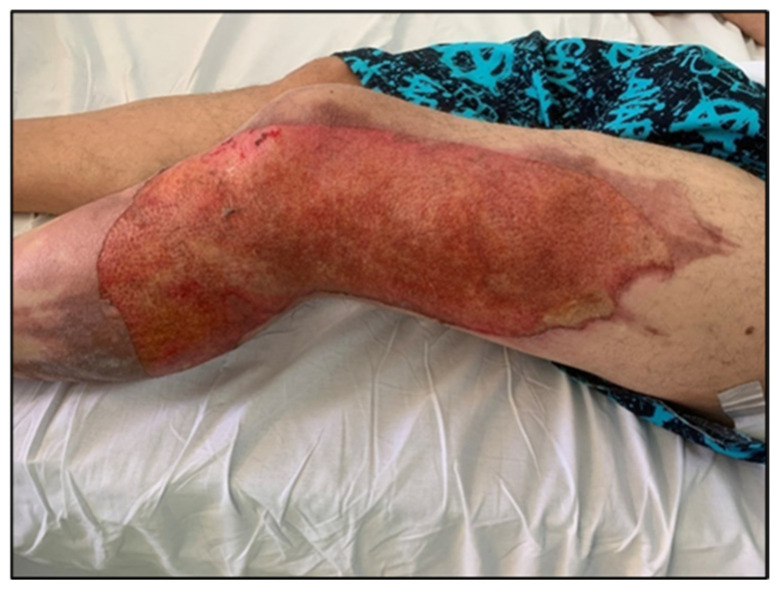
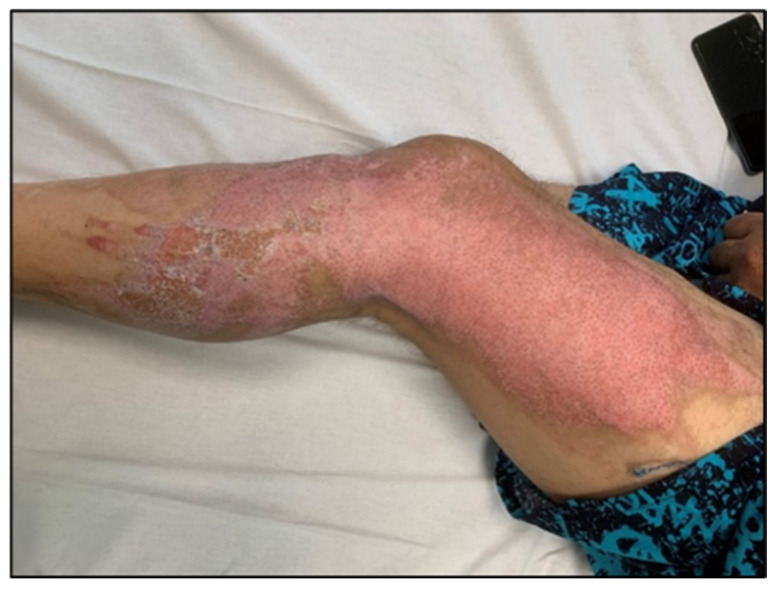 BeforeAfter
Post-burn lesion, lateral lower limb: before and after 10 sessions (Figures 5 & 6).
Protocol: Adjunctive in-clinic MLS (Multiwave Locked System) near-infrared laser therapy + standard burn care, 10 sessions.
Image: Postoiu RL et al., Life (Basel) (2026), Figures 5 & 6 · CC BY 4.0 · Source ↗ · doi:10.3390/life16040611
Individual results vary. Shown unaltered, as published by the source.
References
- Kuffler DP (2016). Photobiomodulation in promoting wound healing: a review. Regen Med. PubMed 26681143
- Zadik Y, Arany PR, Fregnani ER et al. (2019). Systematic review of photobiomodulation for the management of oral mucositis in cancer patients and clinical practice guidelines. Support Care Cancer. PubMed 31286228
- Maghfour J, Mineroff J, Ozog DM et al. (2025). Evidence-based consensus on the clinical application of photobiomodulation. J Am Acad Dermatol. PubMed 40253006